872. Leaf-Similar Trees




Consider all the leaves of a binary tree, from left to right order, the values of those leaves form a leaf value sequence .
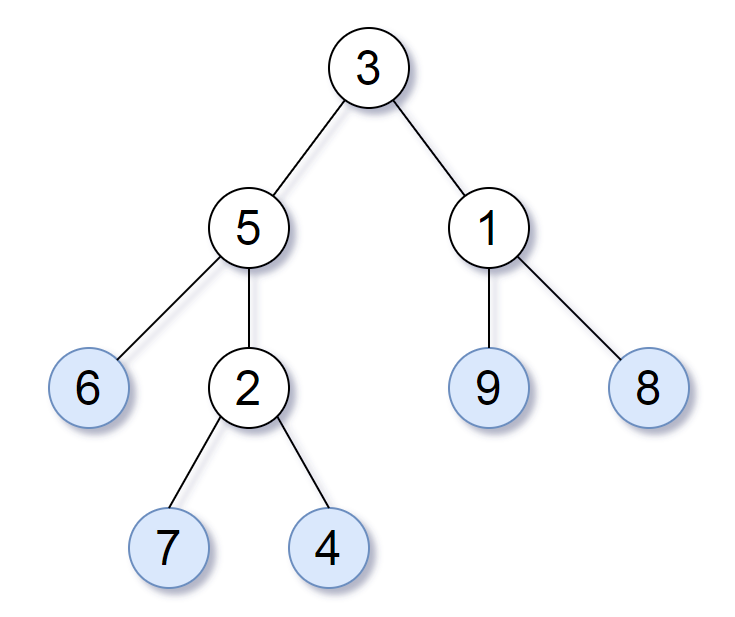
For example, in the given tree above, the leaf value sequence is (6, 7, 4, 9, 8).
Two binary trees are considered leaf-similar if their leaf value sequence is the same.
Return true if and only if the two given trees with head nodes root1 and root2 are leaf-similar.
Example 1:
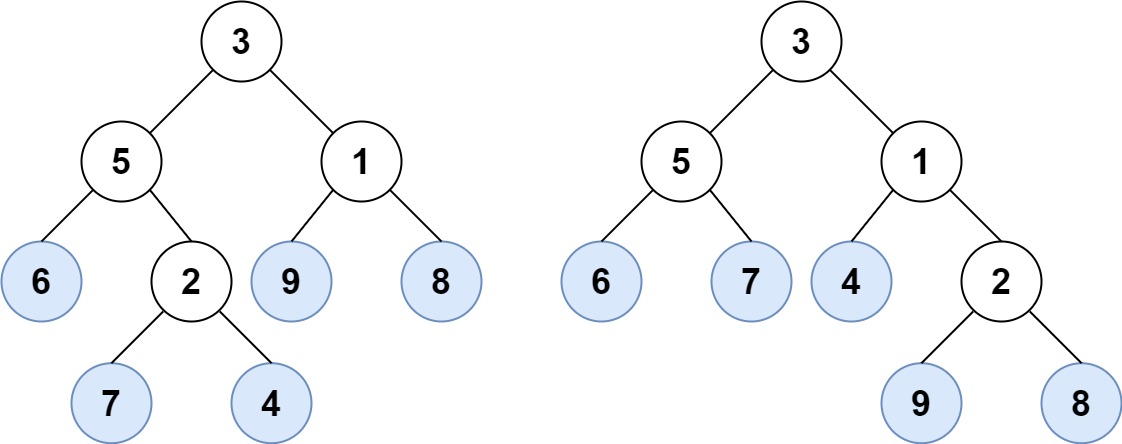
Input: root1 = [3,5,1,6,2,9,8,null,null,7,4], root2 = [3,5,1,6,7,4,2,null,null,null,null,null,null,9,8]
Output: true
Example 2:
Input: root1 = [1], root2 = [1]
Output: true
Example 3:
Input: root1 = [1], root2 = [2]
Output: false
Example 4:
Input: root1 = [1,2], root2 = [2,2]
Output: true
Example 5:
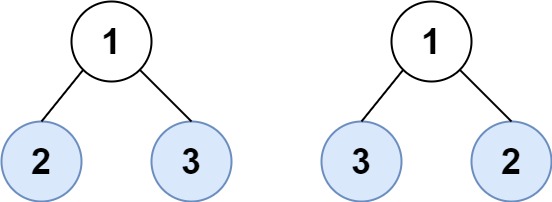
Input: root1 = [1,2,3], root2 = [1,3,2]
Output: false
Constraints:
- The number of nodes in each tree will be in the range
[1, 200]. - Both of the given trees will have values in the range
[0, 200].
# @lc code=start
using LeetCode

function leaf_similar(root1::TreeNode{V}, root2::TreeNode{V})::Bool where {V}
    leaves1 = V[]
    leaves2 = V[]
    find_leaves!(root1, leaves1)
    find_leaves!(root2, leaves2)
    return leaves1 == leaves2
end

function find_leaves!(t::TreeNode, leaves)
    if isnothing(t.left) && isnothing(t.right)
        push!(leaves, t.val)
    else
        find_leaves!(t.left, leaves)
        find_leaves!(t.right, leaves)
    end
end

find_leaves!(::Nothing, leaves) = nothing
# @lc code=end
find_leaves! (generic function with 2 methods)
This page was generated using DemoCards.jl and Literate.jl.